Yesterday was a wonderful day at the annual Knitter's Frolic held at the Japanese Cultural Centre in Toronto. It is definitely worth getting up early on a Saturday to spend the day amid a dizzying amount of yarn in a vast array of colour and textures, and to be among knitters and friends. It was a happy day filled with lots of laughter, sharing ideas and being inspired.
I enjoyed taking a couple of classes with Candace Eisner Strick: 'Creating Crescents' and 'Double Dare'. I enjoyed both classes with Candace who has a great way of teaching combined with a wealth of knowledge and sense of humour - truly a pleasure to meet her and learn new techniques - I'm anxious to introduce them into my designs.
In between classes I had a few hours to shop around the marketplace and found a beautiful stitch pattern book to add to my reference library. I also purchased something called the 'Fleegle Beader' at the BeadFX booth which had people clamoring to purchase this tool used to add beads while knitting.
My favourite yarn was a new yarn called Mrs. Crosby introduced at the Frolic by The Needle Emporium. Julie designed the booth with vintage trunks and suitcases filled with yarn available in five weights in really beautiful colours - it was like finding treasure in those trunks! The Facebook page for Mrs. Crosby describes it as 'more than yarn. She is about inspiring people to follow their muse and fulfill their dreams. She represents every woman’s search for excitement and fulfillment'. There were also quotes from Mrs. Crosby used throughout the displays. I chose 'Hat Box' (a sports weight) in colour Wild Huckleberry.
Sunday, April 27, 2014
Wednesday, April 02, 2014
RIDGED EYELET BORDER
STITCH OF THE MONTH - April 2014
The Ridged Eyelet Border is worked over a background of stockinette stitch. It works well for adding a single border of a simple eyelet lace to a garment or baby items to add some interest and texture. Weaving a pretty satin ribbon or a knitted icord through the eyelets will add a touch of femininity.
Ridged Eyelet Border
(Uneven number of stitches)
Rows 1 thru 3 (RS) Knit
Row 4 *P2tog, yo; repeat from * to last stitch, k1
Row 5 thru 6 Knit
These 6 rows form the Ridged Eyelet Border
Swatch is shown repeated on a stockinette stitch background.
The Ridged Eyelet Border is worked over a background of stockinette stitch. It works well for adding a single border of a simple eyelet lace to a garment or baby items to add some interest and texture. Weaving a pretty satin ribbon or a knitted icord through the eyelets will add a touch of femininity.
Ridged Eyelet Border
(Uneven number of stitches)
Rows 1 thru 3 (RS) Knit
Row 4 *P2tog, yo; repeat from * to last stitch, k1
Row 5 thru 6 Knit
These 6 rows form the Ridged Eyelet Border
Swatch is shown repeated on a stockinette stitch background.
Sunday, March 23, 2014
THE GAUGE SWATCH
What is Gauge?
Gauge is defined as the measurement of the number of stitches and rows per inch required to knit a pattern. A knitted swatch is required to calculate the gauge. It is also known as a 'tension' swatch. The gauge will be affected by the type/weight of yarn, the size of knitting needle used as well as the stitch pattern.
The gauge swatch is knit to a minimum 6"/14 cm square and the stitches (width) and rows (height) are then measured over a 4"/10 cm square. Measuring over less than 4"/10 cm can result in inaccurate stitch/row counts but a 4"/10 cm measurement will ensure that half stitches are included in the count.
The Importance of Checking Your Gauge
Knitters that use the same yarn and same knitting needles may have a different knitting gauge than the other knitters or the designer of the pattern whether the knitter knits a bit looser or a bit tighter. This variance in gauge will affect the overall size and fit of a garment. If a sweater has been designed to have 22 stitches per 4"/10 cm, and it is actually knit to 20 stitches per 4"/10 cm, the finished item will not fit as intended. Gauge is not generally required for scarves and blankets but is crucial for any fitted items such as sweaters.
The gauge will be shown on a pattern as follows:
___ sts x ___ rows = 4"/10 cm using ____ needles.
The information may also indicate the stitch pattern used to obtain the gauge.
If not, consider it to be stockinette stitch.
The pattern will also detail the size of needles to be used under materials,
OR SIZE TO OBTAIN GAUGE.
Knitting the Gauge Swatch
Knit the swatch using the recommended needle size and stitch pattern in a 6"/15 cm square (cast on one-and-a-half times the 4" stitch gauge). Bind off loosely. Measurements should be taken from the center of the square as edges tend to curl in a bit and may be tighter than the knit fabric. It is important to block the swatch before measuring.
Measuring stitch gauge: Place a marker 1"/2.5 cm in from the edge and another marker exactly 4"/10 cm from the first marker. Count the number of stitches between markers including any half stitches (and quarter stitches for chunky yarns). The stitch is the 'v' in the fabric. This will give you the number of stitches for gauge.
Measuring row gauge: Place a marker 1"/2.5 cm up from the bottom and another marker exactly 4"/10 cm from the first marker. Count the rows between the two markers to get your row gauge. It's easier to count the rows on the back of a stockinette stitch swatch because the purl 'bumps' are easier to count.
The markers can be pins or a different colour of yarn but whatever type of marker is used it is important that the marker does not move the stitches apart as this will affect the stitch count.
Adjusting to Meet Gauge
If you have fewer stitches than required for the gauge, go down a needle size.
If you have more stitches than required for gauge, go up a needle size.
It is a good idea to make a note on the pattern of any changes to the needle size.
Gauge is defined as the measurement of the number of stitches and rows per inch required to knit a pattern. A knitted swatch is required to calculate the gauge. It is also known as a 'tension' swatch. The gauge will be affected by the type/weight of yarn, the size of knitting needle used as well as the stitch pattern.
The gauge swatch is knit to a minimum 6"/14 cm square and the stitches (width) and rows (height) are then measured over a 4"/10 cm square. Measuring over less than 4"/10 cm can result in inaccurate stitch/row counts but a 4"/10 cm measurement will ensure that half stitches are included in the count.
The Importance of Checking Your Gauge
Knitters that use the same yarn and same knitting needles may have a different knitting gauge than the other knitters or the designer of the pattern whether the knitter knits a bit looser or a bit tighter. This variance in gauge will affect the overall size and fit of a garment. If a sweater has been designed to have 22 stitches per 4"/10 cm, and it is actually knit to 20 stitches per 4"/10 cm, the finished item will not fit as intended. Gauge is not generally required for scarves and blankets but is crucial for any fitted items such as sweaters.
The gauge will be shown on a pattern as follows:
___ sts x ___ rows = 4"/10 cm using ____ needles.
The information may also indicate the stitch pattern used to obtain the gauge.
If not, consider it to be stockinette stitch.
The pattern will also detail the size of needles to be used under materials,
OR SIZE TO OBTAIN GAUGE.
Knitting the Gauge Swatch
Knit the swatch using the recommended needle size and stitch pattern in a 6"/15 cm square (cast on one-and-a-half times the 4" stitch gauge). Bind off loosely. Measurements should be taken from the center of the square as edges tend to curl in a bit and may be tighter than the knit fabric. It is important to block the swatch before measuring.
Measuring stitch gauge: Place a marker 1"/2.5 cm in from the edge and another marker exactly 4"/10 cm from the first marker. Count the number of stitches between markers including any half stitches (and quarter stitches for chunky yarns). The stitch is the 'v' in the fabric. This will give you the number of stitches for gauge.
Measuring row gauge: Place a marker 1"/2.5 cm up from the bottom and another marker exactly 4"/10 cm from the first marker. Count the rows between the two markers to get your row gauge. It's easier to count the rows on the back of a stockinette stitch swatch because the purl 'bumps' are easier to count.
The markers can be pins or a different colour of yarn but whatever type of marker is used it is important that the marker does not move the stitches apart as this will affect the stitch count.
Adjusting to Meet Gauge
If you have fewer stitches than required for the gauge, go down a needle size.
If you have more stitches than required for gauge, go up a needle size.
It is a good idea to make a note on the pattern of any changes to the needle size.
Saturday, March 01, 2014
HALF LINEN STITCH
STITCH OF THE MONTH – March 2014
The Half Linen stitch (also known as the Woven stitch) gives a woven effect to the knitted fabric. This simple stitch pattern is worked over a four-row repeat adding both interest and texture.
While it resembles a woven fabric the characteristic of the fabric will be the same as stockinette stitch as it will curl at the edges. This will need to be taken into consideration when doing a scarf or blanket by adding a border at the edge such as a seed or moss stitch. It is not reversible but the ‘wrong side’ has a very interesting texture.
There are many variations that can be explored with the pattern such as using two colors (one color for the first and second rows and another color for the third and fourth rows), or a double half linen stitch where two stitches are knit and two stitches are slipped which elongates the horizontal yarn weave.
Half Linen Stitch
(Uneven number of stitches)
Row 1 (WS): Purl.
Row 2: K1, *slip 1 stitch purlwise with yarn in front, k1; repeat from * to end.
Row 3: Purl.
Row 4: K2, *slip 1 stitch purlwise with yarn in front, k1; repeat from * to end.
These 4 rows form the Half Linen stitch pattern.
You will require an even number of stitches to knit this pattern on circular needles:
Row 1 (WS): Purl.
Row 2: *Slip 1 stitch purlwise with yarn in front, k1; repeat from * to end.
Row 3: Purl.
Row 4: *K1, slip 1 stitch purlwise with yarn in front; repeat from * to end.
Friday, February 07, 2014
PANTONE FASHION COLOR REPORT FALL 2014
Pantone® yesterday released their fashion colors for fall 2014 during the
first day of New York Fashion Week. The colors are described as ‘color
that transcends time and space’. “This is a season of untypical colors –
more reflective of the imagination and ingenuity, which makes for an artful
collection of colors and combinations not bound by the usual hues for fall,”
said Leatrice Eiseman, executive director of the Pantone Color Institute.
Fall 2014 offers a diverse
and adventurous color palette that reflects a feminine mystique.
The following are the top 10 colors for Fall 2014:
1. Sangria - an exotic
berry-bright shade of red
2. Aurora Red - a sophisticated red with blue undertones
3. Radiant Orchid - The Pantone 2014
Color of the Year
4. Mauve Mist - a romantic and
feminine shade of purple
5. Cypress - a majestic
forestry green
6. Bright Cobalt - a subtle twist
on the traditional cobalt blue
7. Royal Blue - a versatile
and more complex shade of navy blue
8. Aluminum - silver/grey stainless
steel
9. Cognac - classy and cultured brown hue
10. Misted Yellow - a warm ray of
sunshine
Pantone® is the
global authority on color and provider of professional color standards for the
design industry. The Fashion Color Report is used as a reference tool by
designers in the fashion and home furnishings industry. The colors will
be seen this fall in fashion and home, jewelry and cosmetics.
|
|
|
Saturday, February 01, 2014
PARASOL STITCH (Lace Panel)
STITCH OF THE MONTH – February 2014
Stitch markers help identify the beginning (and the end) of the panel while knitting.
Row 1 (RS) yo, k1 [p3, k1] 4 times, yo
Row 2 and every even row Purl
Row 3 K1, yo, k1, [p3, k1] 4 times, yo, k1 (19 sts)
Row 5 K2, yo, k1 [p3, k1] 4 times, yo, k2 (21 sts)
Row 7 K3, yo, k1 [p2tog, p1, k1] 4 times, yo, k3 (23 sts)
Row 9 K4, yo, k1 [p2tog, k1] 4 times, yo, k4 (25 sts)
Row 11 K5, yo, k1 [k3tog, k1] twice, yo, k5 (17 sts)
Row 12 Purl
These 12 rows form the Parasol stitch.
Note: Count the stiches only after the 11th and 12th rows of the pattern.
Abbreviations
K3tog knit 3 stitches together
p2tog purl 2 stitches together
rep repeat
RS right side
yo yarn over
The Parasol stitch is
a vertical lace stitch pattern that resembles parasols. The pattern is worked
over 17 stitches on a background of stockinette stitch.
A lace panel is a creative way to add textured detail and contrast to a garment. It can be incorporated as a pattern one the front edging of a cardigan, the length of a sleeve, a center panel on a pullover or throughout the garment.
Stitch markers help identify the beginning (and the end) of the panel while knitting.
Row 2 and every even row Purl
Row 3 K1, yo, k1, [p3, k1] 4 times, yo, k1 (19 sts)
Row 5 K2, yo, k1 [p3, k1] 4 times, yo, k2 (21 sts)
Row 7 K3, yo, k1 [p2tog, p1, k1] 4 times, yo, k3 (23 sts)
Row 9 K4, yo, k1 [p2tog, k1] 4 times, yo, k4 (25 sts)
Row 11 K5, yo, k1 [k3tog, k1] twice, yo, k5 (17 sts)
Row 12 Purl
These 12 rows form the Parasol stitch.
Note: Count the stiches only after the 11th and 12th rows of the pattern.
Abbreviations
K3tog knit 3 stitches together
p2tog purl 2 stitches together
rep repeat
RS right side
yo yarn over
Saturday, January 04, 2014
SPRING 2014 FASHION TREND REPORT
The overall theme for the coming season is feminine, sexy, chic, relaxed and sporty.
Floral Patterns
Bared midriffs were a big trend on the runways which featured cropped tops and bralets as well as inverse buttoning where the top few buttons of a top are buttoned and the rest are left undone allowing the top to float open.
![]() |
| Diane von Furstenberg |
The sheer trend continues this season with the use of peekaboo panels, sheer stripes, sheer fabrics over opaque undergarments, as well as semi-translucent layered fabrics giving dimension to garments.
![]() |
| Cushie et Ochs |
Word Play
Text with a play on words were featured as statement pieces on garments and accessories. The text tends to be witty and clever words and statements rather than logos.
![]() |
| Alexander Wang |
The sports luxe trend continues in its popularity this season in styles that are chic, relaxed and casual. An athletic aesthetic of sport-chic included exaggerated v-neck tennis sweaters, racing stripes, perforated fabrics and varsity jackets.
Fringes made of leather, silk and beading were used in a variety of ways from evening to casual wear. The embellishment is modern and adds to the overall feel of fluidity this season.
Wide Leg Pants
The ultra-chic, easy to wear wide leg returns in a billowy silhouette for trousers, Bermuda shorts and culottes.
![]() |
| Emilio Pucci |
The ultra-chic, easy to wear wide leg returns in a billowy silhouette for trousers, Bermuda shorts and culottes.
![]() |
| Daks |
Wednesday, January 01, 2014
BASKETWEAVE STITCH
STITCH OF THE MONTH – January 2014
The Basketweave
stitch creates a beautiful textured pattern giving the fabric a woven appearance.
The stitch pattern uses only knit and purl stitches where the purl blocks appear
to wrap around the knit blocks producing the resemblance to basketweave.
Although the pattern is not a
truly reversible stitch; however, the ‘wrong side’ also has a nice appearance.
This stitch pattern has been is often used for washcloths, blankets and
scarves. The pattern looks complicated but is quite simple to work and easy to
remember.
Basketweave Stitch
(Multiples of 8 stitches
+ 5)
Row 1 (RS): Knit
Row 2: K5, *p3, k5;
rep from * to end
Row 3: P5, *k3, p5; rep from * to end
Row 4: K5, *p3, k5; rep from * to end
Row 5: Knit
Row 6: K1, *p3, k5; rep
from * to last 4 sts, p3, k1
Row 7: P1, *k3, p5; rep
from * to last 4 sts, k3, p1
Row 8: K1, *p3, k5; rep
from * to last 4 sts, p3, k1
These 8 rows form
the Basketweave stitch pattern.
Abbreviations
rep repeat
RS right side
st(s) stitch(es)
Thursday, December 05, 2013
RADIANT ORCHID: Pantone's Colour of the Year for 2014
Today Pantone®
announced RADIANT ORCHID 18-3224 as the Colour of the Year for 2014, a vibrant
and captivating harmony of fuchsia, purple and pink undertones. Radiant Orchid
inspires confidence and magical warmth that intrigues the eye and sparks the
imagination.
“An invitation to innovation, Radiant Orchid encourages
expanded creativity and originality, which is increasingly valued in today’s
society,” said Leatice Eiseman, executive director of the Pantone Color
Institute®. “An enchanting harmony of fuchsia, purple and pink undertones,
Radiant Orchid inspires confidence and emanates great joy, love and health. It
is a captivating purple, one that draws you in with its beguiling charm.”
Fashion
Radiant Orchid was a shade that dominated the runways during the spring 2014 fashion shows and has already made its way onto the red carpet.
Beauty
This modern and versatile shade enlivens the skin with a blend of both cool and warm undertones. It's a flattering hue and makes all who wear it feel more healthy and energetic. Celebrities have been quick to embrace this colour through the use of eye shadow, liner, lipstick and nail polish.
Interiors
Radiant Orchid is an adaptable colour
that can spruce up interior spaces by incorporating this eye-catching hue in
paint, accent pieces and accessories. It complements olive and deeper hunter
greens, and offers a beautiful combination when paired with turquoise and teal.
It is an uplifting and bold colour without being overpowering.
While Emerald, the 2013 colour of the year, served as a
symbol of growth, renewal and prosperity, Radiant Orchid reaches across the
colour wheel to intrigue the eye and spark the imagination.
Sunday, December 01, 2013
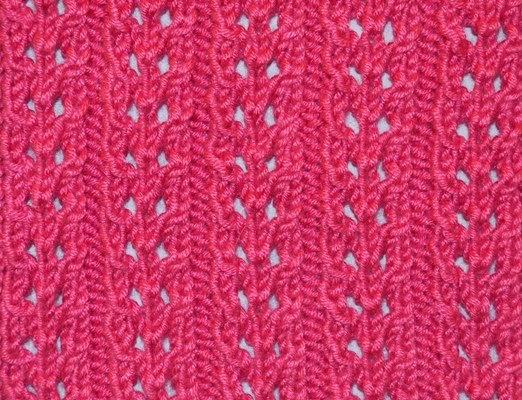
DOUBLE EYELET RIB
STITCH OF THE MONTH – December 2013
The Double Eyelet Rib is a variation
of the rib stitch that creates a lovely texture featuring columns of eyelet lace.
It can be used for edgings and cuffs where a ribbed pattern is required or can
be used as an inset panel. The ribbing tends to ‘shrink’ through the width
which should be taken into consideration if using it as an all-over stitch
pattern.
It’s a popular
pattern that is prominently featured in baby patterns but is also used for
socks, scarves and afghans.
Double Eyelet Rib
Stitch
(Multiples of 7 stitches
+ 2)
Row 1 (RS): p2, *k5,
p2; repeat from * to end
Row 2: k2, *p5,
k2; repeat from * to end
Row 3: p2, *k2tog,
yo, k1, yo, skp, p2; repeat from * to end
Row 4: k2, *p5,
k2; repeat from * to end
These 4 rows form
the Double Eyelet Rib stitch pattern.
Abbreviations
k2tog knit 2 stitches together
RS right side
skp slip one stitch, knit one stitch, pass
slipped stitch over
yo yarn over
Sunday, November 03, 2013
RIDGED RIB
Stitch of the Month - November 2013
The alternating knit and purl stitches of ribbing ensures that the fabric does not curl. This inherent characteristic of ribbed knitting stitches will ensure that the knitted fabric will lay flat. This makes it particularly useful for edges of garments such as cuffs, hems, as well as scarves and blankets or any other project where you need the vertical and horizontal edges to remain flat.
Row 1 (RS): Knit.
Row 2: Knit.
Row 3: P1, *k1, p1; rep from * to end.
Row 4: K1, *p1, k1; rep from * to end.
These 4 rows form the pattern.
Row 1 (RS): Knit.
Row 2: Purl.
Row 3: *k1, p1; rep from * to end.
Row 4: *k1, p1; rep from * to end.
These 4 rows form the pattern.
The alternating knit and purl stitches of ribbing ensures that the fabric does not curl. This inherent characteristic of ribbed knitting stitches will ensure that the knitted fabric will lay flat. This makes it particularly useful for edges of garments such as cuffs, hems, as well as scarves and blankets or any other project where you need the vertical and horizontal edges to remain flat.
The Ridged Rib adds an interesting texture to the basic ‘knit one, purl
one’ ribbing by adding two garter stitch rows into the stitch pattern.
Ridged Rib
(Straight Needles)
(Multiples of 2 + 1
stitch)Row 1 (RS): Knit.
Row 2: Knit.
Row 3: P1, *k1, p1; rep from * to end.
Row 4: K1, *p1, k1; rep from * to end.
These 4 rows form the pattern.
Ridged Rib
(Circular Needles)
(Even number of
stitches)Row 1 (RS): Knit.
Row 2: Purl.
Row 3: *k1, p1; rep from * to end.
Row 4: *k1, p1; rep from * to end.
These 4 rows form the pattern.
Abbreviations
RS - Right side
Rep – Repeat
RS - Right side
Rep – Repeat
Subscribe to:
Posts (Atom)