Friday, December 09, 2016

Pantone Color of the Year for 2017 is GREENERY

Pantone® has named Greenery as the color of the year for 2017 citing it as a refreshing and revitalizing shade symbolic of new beginnings.
❝Greenery bursts forth in 2017 to provide us with the reassurance we yearn for amid a tumultuous social and political environment. Satisfying our growing desire to rejuvenate and revitalize. Greenery symbolizes the reconnection we seek with nature, one another and a larger purpose.❞  Leatrice Eiseman, Executive Director of the Pantone Color Institute 
Greenery is synonymous with nature's growth - foliage, vegetation, plant life, flora, verdure and herbage. It not only sustains us by producing oxygen, purifying the air and giving us medicine, greenery also provides us with natural aesthetic beauty. 


Greenery is characterized as a yellowish-green shade. It pairs well with other shades making it a versatile color to add to many palettes. Pantone has paired it with 10 different palettes that includes neutrals, brights, deeper shades, pastels and metallics. It's a grounding color much like nature where flowers reveal their beauty against what can be considered a neutral background.

I'm always drawn to this shade of green. It makes me think of springtime when the new leaves and fresh new grass first burst to life and there is an excitement to get out and enjoy the outdoors and reconnect with people after a long winter season. I associate greenery with hope and rejuvenation.

Tuesday, December 06, 2016

SEAFOAM STITCH

Stitch of the Month - December 2016
The Seafoam stitch has a unique and interesting texture. It’s a reversible stitch pattern that resembles waves. The stitch pattern is created by making yarn overs and then dropping them on the following row. It an easy way to create a pattern that looks like lace but is worked using only knit stitches and yarn overs.

There are numerous stitch pattern books that have the pattern as *[yo] twice, k1, [yo] 3 times, k1, [yo] 4 times, k1, [yo] 3 times, k1, [yo] twice, k6*. You may want to experiment with it in place of the stitch pattern below in rows 3 and 7 but I found that the elongated yarns from the dropped stitches looked a bit too loose.

The stitch works well for scarves, shawls and summer sweaters. I particularly like the Seafoam pattern when it’s knit with a variegated yarn.


Seafoam Stitch
(Multiples of 10 stitches + 6)
Row 1 (RS) Knit
Row 2  Knit
Row 3  K6, *yo, k1, [yo] twice, k1, [yo] 3 times, k1, [yo] twice, k1, yo, k6; repeat from * to end
Row 4  Knit while dropping all yarn overs from needle
Row 5  Knit
Row 6  Knit
Row 7  K1, *yo, k1, [yo] twice, k1, [yo] 3 times, k1, [yo] twice, k1, yo, k6; repeat from * to last 5 sts, yo, k1, [yo] twice, k1, [yo] 3 times, k1 [yo] twice, k1, yo, k1. 
Row 8  Knit while dropping all yarn overs from needle
These 8 rows form the Seafoam stitch pattern

Abbreviations
RS  right side
yo   yarn over

Friday, November 25, 2016

WORLD OF THREADS EXHIBITION 2016

The World of Threads Festival is showcasing local, national and international contemporary and textile artists.The festival is in full swing and I had the chance to see the exhibition at the Queen Elizabeth Park Community and Cultural Centre in Oakville, Ontario and found a couple of amazing knitted pieces that are true works of art.

Brigitte Amarget | Seine-Port, France

WOMEN IN WAR FOR PEACE
Along the Cat Walk & Kimono Road corridor were amazing displays of fibre/textile clothing. Here I found a beautiful piece that was created from x-rays, reflective materials, threads and nylon thread. The techniques included knitting, numerical treatment of Tsubas for laser engraving and cutting on x-rays, as well as hand and machine sewing.


Chris Motley | San Francisco, California
BROWN IS THE NEW GREEN  
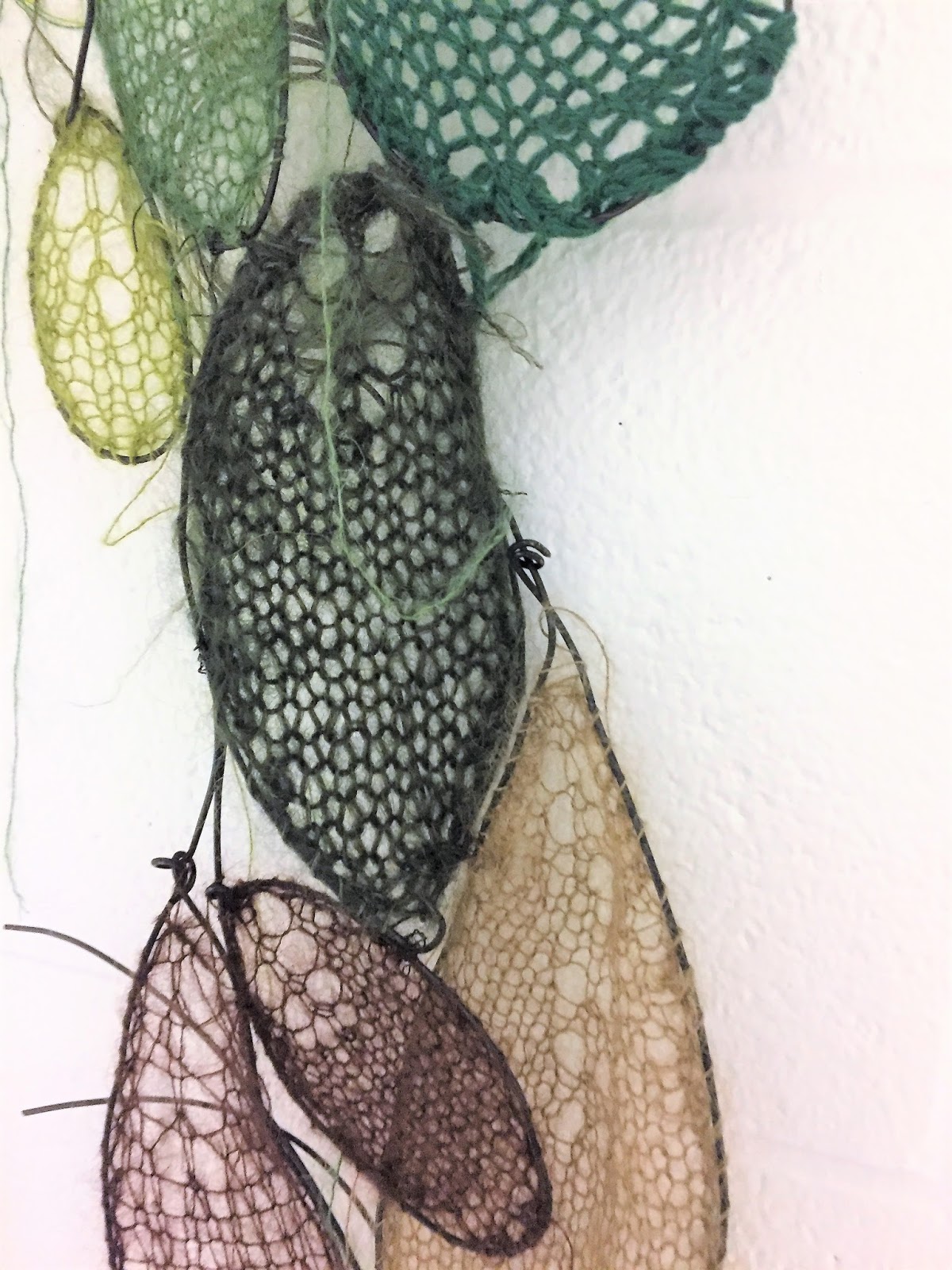
The Quiet Zone 2 Corridor featured artwork that was meant to give "visitors the opportunity to pause, to breathe, and to relax amidst muted colours, receptive forms and an imperturbable stillness". Chris has used wool yarn, wire and thread to create this beautiful piece through the use of hand knitting, fulling, sewing and assemblage.


There is a tremendous world of possibilities to transcend yarn into amazing works of art. 

Monday, November 14, 2016

VINE LACE

Stitch of the Month - November 2016
The vine lace is a lovely stitch that is worked over a four-row pattern repeat. There is only one nine-stitch pattern repeat to memorize and which is staggered over two rows of lace pattern.

The edging also has a scalloped edge. I found that the edge still curled slightly but not as dramatically as stockinette stitch and laid flat after blocking.


Vine Lace
(Multiples of 9 stitches + 4)
Row 1  Purl
Row 2 - (RS) - K3, *yo, k2, ssk, k2tog, k2, yo, k1; repeat from * to last st, k1.
Row 3 - Purl
Row 4 - K2, *yo, k2, ssk, k2tog, k2, yo, k1; repeat from * to last 2 sts, k2.
(These 4 rows form the Vine Lace stitch pattern)

Friday, October 07, 2016

CANDLE FLAMES

Stitch of the Month - October 2016
The Candle Flame stitch pattern is worked against a reverse stockinette background where the candle flames seems to be raised from the fabric much like a cable stitch. The pattern is worked over a multiple of 12 stitches that are increased and decreased over 24 rows; only count stitches on 12th and 24th rows.

This is an absolutely beautiful stitch pattern that looks wonderful in a scarf or shawl.


Candle Flames
(Multiples of 12 stitches + 2)
Row 1 - *P2, yo, k1, yo, p2, k2, k2tog, k3; end p2.
Row 2 - *K2, p6, k2, p3; end k2.
Row 3 - *P2, k1, (yo, k1) twice, p2, k2, k2tog, k2; end p2.
Row 4 - *(K2, p5) twice; k2.
Row 5 - *p2, k2, yo, k1, yo, k2, p2, k2, k2tog, k1; end p2.
Row 6 - *K2, p4, k2, p7; end k2.
Row 7 - *P2, k3, yo, k1, yo, k3, p2, k2, k2tog; end p2.
Row 8 - *k2, p3, k2, p9; end k2.
Row 9 - *P2, k2, k2tog, k5, p2, k1, k2tog; end p2.
Row 10 -*K2, p2, k2, p8; end k2.
Row 11 - *P2, k2, k2tog, k4, p2, k2tog; end p2.
Row 12 - *k2, p1, k2, p7; end k2.
Row 13 - *P2, k2, k2tog, k3, p2, yo, k1, yo; end p2.
Row 14 - *K2, p3, k2 p6; end k2.
Row 15 - *P2, k2, k2tog, k2, p2, (k1, yo) twice, k1; end p2.
Row 16 - *(K2, p5) twice, end k2.
Row 17 - *P2, k2, k2tog, k1, p2, k2, yo, k1, yo, k2; end p2.
Row 18 - *K2, p7, k2, p4; end k2 .
Row 19 - *P2, k2, k2tog, p2, k3, yo, k1, yo, k3; end p2.
Row 20 - *K2, p9, k2, p3; end k2.
Row 21 - *P2, k1, k2tog, p2, k2, k2tog, k5; end p2.
Row 22 - *K2, p8, k2, p2; end k2.
Row 23 - *P2, k2tog, p2, k2, k2tog, k4; end p2.
Row 24 - *K2, p7, k2, p1; end k2.
(These 24 rows form the Candle Flames Stitch Pattern)


Monday, September 05, 2016

GRANDMOTHER'S EDGING

STITCH OF THE MONTH – September 2016
Grandmother’s Edging stitch pattern is a lovely lace edging pattern stitch that features a slight waving curve at the edge best added to straight edges.

The pattern was published in 1891 in a book entitled Home Work: A Choice Collection of Useful Designs for the Crochet and Knitting Needle.


Grandmother’s Edging
CO 15sts
Row 1 – K2, yo, p2tog, k7, yo, k2tog, k2.
Row 2 – P11, yo, p2tog, k2.
Row 3 – K2, yo, p2tog, k3, k2tog, k2, (yo, k2tog) twice.
Row 4 – P10, yo, p2tog, k2.
Row 5 – K2, yo, p2tog, k2, k2tog, k2, yo, k2tog, k2.
Row 6 – P9, yo, p2tog, k2.
Row 7 – K2, yo, p2tog, k1, k2tog, k2, (yo, k2tog) twice.
Row 8 – P8, yo, p2tog, k2.
Row 9 – K2, yo, p2tog, k2tog, k2, yo, k1, yo, k3.
Row 10 – P9, yo, p2tog, k2.
Row 11 – K2, yo, p2tog, k2tog, k1, yo, k3, yo, k1, yo, k2tog.
Row 12 – P10, yo, p2tog, k2.
Row 13 – k2, yo, p2tog, k2tog, yo, k5, yo, k3.
Row 14 – P11, yo, p2tog, k2.
These 14 rows form the Grandmother's Edging stitch pattern.

Wednesday, August 03, 2016

INDIAN CROSS STITCH

STITCH OF THE MONTH - August 2016
The Indian Cross Stitch features elongated stitches that are then crossed creating a unique, open and airy stitch pattern. The garter stitch between the crossed stitches makes this a reversible stitch.

The elongated stitches can be a bit awkward to knit. Slip the stitches purlwise so that the stitches are on the needle sitting in the correct position to knit the stitch. Give a little tug once you've slipped the stitches when dropping the yarn over just to make sure that all the stitches are in the right order.

While this stitch works well for scarves and blankets, I would avoid using it for baby garments or baby blankets because their little fingers or toes can get caught in the strands of yarn.


Indian Cross Stitch
(Multiples of 8 stitches)
Rows 1 thru 4  Knit
Row 5  K1, *insert needle into next st wrapping yarn around needle 4 times, then knit that stitch drawing the 4 wraps through the st; rep from * to last st, k1. 
Row 6  *Cross 8 sts; repeat from * to end.
Rows 7 thru 10  Knit
Row 11  K1, *insert needle into next st wrapping yarn around needle 4 times, then knit that stitch drawing the 4 wraps through the st; rep from * to last st, k1. 
Row 12  Cross 4 sts, *Cross 8 sts; repeat from * to last for sts; end Cross 4 sts
These 12 rows form the Indian Cross Stitch Pattern

Abbreviations
Cross 4 sts Slip 4 sts wyib, dropping all extra wraps creating 4 long sts on RH needle. Insert LH needle into the first 2 of these long sts and pass them over the second 2 long sts. 
Cross 8 sts - Slip 8 sts wyib, dropping all extra wraps creating 8 long sts on right-hand needle. Insert left-hand needle into the first 4 of these long sts and pass them over the second 4 long sts. Return all sts to left-hand needle and knit the sts in the new order (knit the second 4 long sts first and then the original 4 sts).
wyib - with yarn in back

Monday, July 04, 2016

ZIGZAG EYELETS

STITCH OF THE MONTH - July 2016
A pretty zigzag of left-slanting and right-slanting eyelets make up this stitch pattern created with a combination of yarn overs and decreases.

This stitch is produced on a background of stockinette so the knit fabric will naturally curl at the edges. This can be avoided by creating a garter stitch, stitch stitch or ribbed border or edging.


Zigzag Eyelet Stitch
(Multiples of 9 stitches)
Row 1 (RS) - K4, *yo, skp, k7; repeat from * to last 5 sts, yo, skp, k3.
Row 2 and every even row - Purl
Row 3 - K5, *yo, skp, k7; repeat from * to last 4 sts, yo, skp, k2.
Row 5 - K6, *yo, skp, k7; repeat from * to last 3 sts, yo, skp, k1.
Row 7 - K7, *yo, skp, k7; repeat from * to last 2 sts, yo, skp.
Row 9 - K3, *k2tog, yo, k7; repeat from * to last 6 sts, k2tog, yo, k4.
Row 11 - K2, *K2tog, yo, k7; repeat from * to last 7 sts, k2tog, yo, k5.
Row 13 - K1, *K2tog, yo, k7; repeat from * to last 8 sts, k2tog, yo, k6.
Row 15 - *K2tog, yo, k7; repeat from * to end.
Row 16 - Purl
These 16 rows make up the Zizag Eyelet stitch pattern.

Abbreviations
k2tog - knit 2 stitches together
RS - right side
skp - slip 1, knit 1, passed slipped stitch over

Wednesday, June 01, 2016

BASKET CABLE

Stitch of the Month – June 2016
The Basket Cable stitch is an all-over cable pattern that produces a thick and highly-textured fabric. It resembles an intricate basket weave and looks more complicated than it actually is to knit.

The dense texture of this stitch pattern will:
  1. significantly narrow the gauge because the stitches are twisting throughout the row so it will be really important to check the gauge (and critical when combining the Basket Cable pattern with another stitch pattern)
  2. will use more yarn vs a knit/purl stitch pattern
  3. require additional ease in garments because of the thickness of the fabric
This dense fabric is best knit with a yarn that has elasticity so that the weight of the cables doesn't cause the garment to 'grow' in length so avoid using yarns such as cotton, silk or linen that are inelastic.


Basket Cable
(Multiples of 8 sts + 4)
Row 1, 3 (RS) - Knit
Row 2 and all even rows - Purl
Row 5 - K4, *C8B; repeat from * to end of row
Row 7, 9 - Knit
Row 11 - *C8F; repeat from * to last 4 stitches, k4
Row 12 - Purl
These 12 rows form the Basket Cable Pattern.

Abbreviations
C8B - Cable 8 back. This is worked by sliding 4 stitches from the left needle onto a cable needle. Move the cable needle to behind the left needle. Knit the next 4 stitches from the left needle and then knit the 4 stitches from the cable needle.
C8F - Cable 8 front. This is worked by sliding 4 stitches from the left needle onto a cable needle. Move the cable needle in front of the left needle. Knit the next 4 stitches from the left needle and then knit the 4 stitches from the cable needle.


Monday, May 02, 2016

HUGS & KISSES CABLE STITCH

STITCH OF THE MONTH - May 2016
The Hugs and Kisses Cable Stitch is a pretty cable pattern that features columns of 'x's and 'o's representing hugs and kisses. The cable pattern is worked over 8 stitches with a 16 row repeat.

The stitch creates a dense pattern that is great for sweaters, blankets and pillows. It's particularly lovely when worked with larger or more complicated cable patterns. How cute to include hugs and kisses into a child's garment!

Cable stitches are worked over a background of reverse stockinette stitches so that the cables "pop" and show well against the background. 

Hugs & Kisses Cable Stitch
(Multiples of 8 stitches)
Row 1 - Knit
Row 2 - Purl
Row 3 - C4F, C4B
Row 4 - Purl
Row 5 - Knit
Row 6 - Purl
Row 7 - C4F, C4B
Rows 8 - 10 -  Repeat rows 4 thru 6
Row 11 - C4B, C4F
Rows 12 - 14 - Repeat rows 4 thru 6
Row 15 - C4B, C4F
Row 16 - Purl
(These 16 rows form the Hugs and Kisses Cable stitch)

Abbreviations
C4B  Cable 4 Back  
C4F  Cable 4 Front

Abbreviations
C4B - Cable over 4 stitches to the back. This is worked by sliding 2 stitches from the left needle onto a cable needle. Move the cable needle to behind the left needle. Knit the next 2 stitches from the left needle and then knit the 2 stitches from the cable needle.
C4F - Cable over 4 stitches to the front. This is worked by sliding 2 stitches from the left needle onto a cable needle. Move the cable needle in front of the left needle. Knit the next 2 stitches from the left needle and then knit the 2 stitches from the cable needle.

Wednesday, April 06, 2016

GOOSEBERRY STITCH

Stitch of the Month – April 2016
The Gooseberry Stitch is a bobble stitch that is formed by working increases in one stitch which is then decreased back to one stitch over four rows. The resulting effect is a heavily textured, three-dimensional design resembling gooseberries.

It is good to note that you will need more yarn than you typically would when knitting straight stockinette stitch. 

Gooseberry Stitch
(Uneven number of stitches)
Row 1 (RS)  Knit
Row 2  K1, *(p1, yo, p1, yo, p1) in next st, k1; repeat from * to end.
Row 3  Purl
Row 4  K1, *sl2 wyif, p3tog, p2sso, k1; repeat from * to end.
Row 5  Knit
Row 6  k2, *(p1, yo, p1, yo, p1) in next st, k1; repeat from * to last st, k1.
Row 7  Purl
Row 8  K2, *sl2 wyif, p3tog, p2sso, k1; repeat from * to last st, k1.
These 8 rows form the Gooseberry Stitch Pattern

Abbreviations
sl2 - slip 2 stitches 
p3tog - purl 3 stitches together
p2sso - pass 2 slipped stitches over
wyif - with yarn in front